World Cup· Season 2026
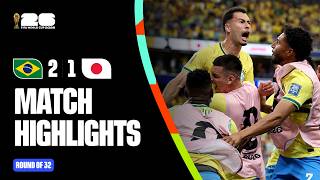
Gabriel Martinelli scored a dramatic stoppage-time winner as Brazil came from behind to beat Japan 2-1 at NRG Stadium, Houston, in the World Cup Round of 32.
Match Videos

Match Analysis
AI SummaryHow It Unfolded
Japan stunned Brazil after 29 minutes. Kaishu Sano intercepted a misplaced pass in midfield, advanced to the edge of the box and drilled a right-footed shot past the goalkeeper to give the Samurai Blue a 1-0 lead — a goal that stood until half-time.
Brazil emerged transformed after the break. Carlo Ancelotti withdrew the injured Lucas Paquetá (left ankle) and introduced 19-year-old Endrick at half-time, injecting urgency into a side that had managed little in the first 45 minutes.
Casemiro equalised in the 56th minute. Gabriel Magalhães rose to head a corner across goal, and Casemiro — having just missed a similar chance two minutes earlier — powered a header that deflected off a defender and off goalkeeper Zion Suzuki's face before nestling in the net.
Vinicius Junior almost put Brazil ahead in the 58th minute, cutting in from the left and forcing a sharp save from Suzuki, who tipped the shot around the post.
The Turning Point
Ancelotti's substitutions defined the second half. Endrick's introduction at half-time shifted Brazil's tempo, but it was the Italian's third change — Arsenal winger Gabriel Martinelli replacing Matheus Cunha in the 66th minute — that ultimately decided the tie.
Martinelli had been on the pitch for 32 minutes when, deep in stoppage time, Bruno Guimarães — himself a half-time survivor despite a poor first half — found Martinelli in the box. The Arsenal forward finished calmly past Suzuki in the 90+8th minute, sparking delirium among the Brazil bench and the Houston crowd.
The goal was the latest knockout-stage winner Brazil have scored in a single-match tie since their data records began.
Key Performers
Gabriel Martinelli (Brazil) — Player of the Match. Introduced in the 66th minute, the Arsenal winger provided the game's decisive moment with a composed stoppage-time finish. One shot, one goal.
Casemiro (Brazil) — Struggled in the first half against Japan's energetic midfield, his distribution erratic and defensive coverage stretched. But he equalised with a crucial header early in the second half and justified Ancelotti's decision to keep him on.
Kaishu Sano (Japan) — Scored a well-taken opener with an interception and finish that showcased why he plays in the Bundesliga for Mainz. Also booked for a first-half foul but was Japan's most effective player.
Zion Suzuki (Japan) — Made several key saves to keep Japan level after the equaliser, including tipping Vinicius Junior's curling effort wide and blocking a Bruno Guimarães header early in the second half.
By The Numbers — Interpreted
Brazil's 69% possession and 19 shots (7 on target) to Japan's 5 (2 on target) tell a story of one-sided second-half dominance, not a balanced contest. The xG gap — Brazil 1.69, Japan 0.23 — underlines how little Japan created after their early goal. Japan's goal came from a defensive error rather than sustained pressure; after scoring, they managed just 0.07 xG for the remainder of the match.
Brazil had 4 corners to Japan's 1, reflecting their territorial control after the break. The five yellow cards (three for Japan, two for Brazil) reflected a physically competitive tie, but neither side was reduced in numbers.
What It Means
Brazil advance to the Round of 16, where they will face the winner of Ivory Coast vs Norway on Sunday 5 July at MetLife Stadium in East Rutherford, New Jersey.
Japan exit the World Cup in the knockout stage for the third consecutive tournament and have still never won a knockout match at a World Cup. Their run — unbeaten in 10 games before this defeat — ends with this loss, and they finish the tournament having gone further than several seeded nations but ultimately unable to break their knockout hoodoo.
The victory was Brazil's 12th in 15 meetings with Japan (2 draws, 1 Japan win) and came on the anniversary of Brazil's first World Cup triumph in Sweden in 1958, when a 17-year-old Pelé scored twice in the final.
Verdict
Japan executed their gameplan perfectly for 45 minutes, but Carlo Ancelotti's half-time adjustments — and a bench that included genuine game-changers — proved too much. Brazil were lethargic and disjointed in the first half but showed the resilience of a tournament heavyweight in the second. Martinelli's late winner was the difference between a cagey extra-time grind and a statement of intent. Japan can hold their heads high; Brazil move on, aware they cannot afford another slow start.
Match Events
Brazil and Japan have met 4 times — Brazil won 3, Japan won 1, with 0 draws. Their rivalry dates back to 2013. Brazil leads the head-to-head with 3 victories from 4 meetings. A combined 13 goals have been scored across these fixtures, averaging 3.25 per match (9 for the home side, 4 for the visitors). Both teams scored in 2 matches (50%). Over 2.5 goals landed in 3 games (75%), making it a fixture that tends to produce goals. The highest-scoring encounter finished 3–2 in 2025.
Statistics are for informational purposes only. Past performance does not guarantee future results.
API data: 1 Jul 2026